Real Estate Blogs In Nigeria
JCulture Name
Nigerian
Orientation
Identification. Though there is archaeological evidence that societies have been living in Nigeria for more than twenty-five hundred years, the borders of modern Nigeria were not created until the British consolidated their colonial power over the area in 1914.
The name Nigeria was suggested by British journalist Flora Shaw in the 1890s. She referred to the area as Nigeria, after the Niger River, which dominates much of the country's landscape. The word niger is Latin for black.
More than 250 ethnic tribes call present-day Nigeria home. The three largest and most dominant ethnic groups are the Hausa, Yoruba, and Igbo (pronounced ee-bo). Other smaller groups include the Fulani, Ijaw, Kanuri, Ibibio, Tiv, and Edo. Prior to their conquest by Europeans, these ethnic groups had separate and independent histories. Their grouping together into a single entity known as Nigeria was a construct of their British colonizers. These various ethnic groups never considered themselves part of the same culture. This general lack of Nigerian nationalism coupled with an ever-changing and often ethnically biased national leadership, have led to severe internal ethnic conflicts and a civil war. Today bloody confrontations between or among members of different ethnic groups continue.
Location and Geography. Nigeria is in West Africa, along the eastern coast of the Gulf of Guinea, and just north of the equator. It is bordered on the west by Benin, on the north by Niger and Chad, and on the east by Cameroon. Nigeria covers an area of 356,669 square miles (923,768 square kilometers), or about twice the size of California.
Nigeria has three main environmental regions: savanna, tropical forests, and coastal wetlands. These environmental regions greatly affect the cultures of the people who live there. The dry, open grasslands of the savanna make cereal farming and herding a way of life for the Hausa and the Fulani. The wet tropical forests to the south are good for farming fruits and vegetables—main income producers for the Yoruba, Igbo, and others in this area. The small ethnic groups living along the coast, such as the Ijaw and the Kalabari, are forced to keep their villages small due to lack of dry land. Living among creeks, lagoons, and salt marshes makes fishing and the salt trade part of everyday life in the area.
The Niger and Benue Rivers come together in the center of the country, creating a "Y" that splits Nigeria into three separate sections. In general, this "Y" marks the boundaries of the three major ethnic groups, with the Hausa in the north, the Yoruba in the southwest, and the Igbo in the southeast.
Politically, Nigeria is divided into thirty-six states. The nation's capital was moved from Lagos, the country's largest city, to Abuja on 12 December 1991. Abuja is in a federal territory that is not part of any state. While Abuja is the official capital, its lack of adequate infrastructure means that Lagos remains the financial, commercial, and diplomatic center of the country.
Demography. Nigeria has the largest population of any African country. In July 2000, Nigeria's population was estimated at more than 123 million people. At about 345 people per square mile, it is also the most densely populated country in Africa. Nearly one in six Africans is a Nigerian. Despite the rampages of AIDS, Nigeria's population continues to grow at about 2.6 percent each year. The Nigerian population is very young. Nearly 45 percent of its people are under age fourteen.
With regard to ethnic breakdown, the Hausa-Fulani make up 29 percent of the population, followed by the Yoruba with 21 percent, the Igbo with
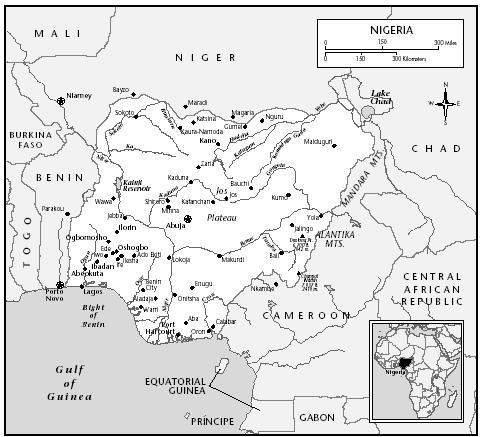
Major urban centers include Lagos, Ibidan, Kaduna, Kano, and Port Harcourt.
Linguistic Affiliations. English is the official language of Nigeria, used in all government interactions and in state-run schools. In a country with more than 250 individual tribal languages, English is the only language common to most people.
Unofficially, the country's second language is Hausa. In northern Nigeria many people who are not ethnic Hausas speak both Hausa and their own tribal language. Hausa is the oldest known written language in West Africa, dating back to before 1000 C.E.
The dominant indigenous languages of the south are Yoruba and Igbo. Prior to colonization, these languages were the unifying languages of the southwest and southeast, respectively, regardless of ethnicity. However, since the coming of the British and the introduction of mission schools in southern Nigeria, English has become the language common to most people in the area. Today those who are not ethnic Yorubas or Igbos rarely speak Yoruba or Igbo.
Pidgin, a mix of African languages and English, also is common throughout southern Nigeria. It basically uses English words mixed into Yoruban or Igbo grammar structures. Pidgin originally evolved from the need for British sailors to find a way to communicate with local merchants. Today it is often used in ethnically mixed urban areas as a common form of communication among people who have not had formal education in English.
Symbolism. Because there is little feeling of national unity among Nigeria's people, there is little in terms of national symbolism. What exists was usually created or unveiled by the government as representative of the nation. The main national symbol is the country's flag. The flag is divided vertically into three equal parts; the center section is white, flanked by two green sections. The green of the flag represents agriculture, while the white stands for unity and peace. Other national symbols include the national coat of arms, the national anthem, the National Pledge (similar to the Pledge of Allegiance in the United States), and Nigeria's national motto: Peace and Unity, Strength and Progress.
History and Ethnic Relations
Emergence of the Nation. Every ethnic group in Nigeria has its own stories of where its ancestors came from. These vary from tales of people descending from the sky to stories of migration from far-off places. Archaeologists have found evidence of Neolithic humans who inhabited what is now Nigeria as far back as 12,000 B.C.E.
The histories of the people in northern and southern Nigeria prior to colonization followed vastly different paths. The first recorded empire in present-day Nigeria was centered in the north at Kanem-Borno, near Lake Chad. This empire came to power during the eighth century C.E. By the thirteenth century, many Hausa states began to emerge in the region as well.
Trans-Sahara trade with North Africans and Arabs began to transform these northern societies greatly. Increased contact with the Islamic world led to the conversion of the Kanem-Borno Empire to Islam in the eleventh century. This led to a ripple effect of conversions throughout the north. Islam brought with it changes in law, education, and politics.
The trans-Sahara trade also brought with it revolutions in wealth and class structure. As the centuries went on, strict Islamists, many of whom were poor Fulani, began to tire of increasing corruption, excessive taxation, and unfair treatment of the poor. In 1804 the Fulani launched a jihad, or Muslim holy war, against the Hausa states in an attempt to cleanse them of these non-Muslim behaviors and to reintroduce proper Islamic ways. By 1807 the last Hausa state had fallen. The Fulani victors founded the Sokoto Caliphate, which grew to become the largest state in West Africa until its conquest by the British in 1903.
In the south, the Oyo Empire grew to become the most powerful Yoruban society during the sixteenth century. Along the coast, the Edo people established the Benin Empire (not to be confused with the present-day country of Benin to the west), which reached its height of power in the fifteenth and sixteenth centuries.
As in the north, outsiders heavily influenced the societies of southern Nigeria. Contact with Europeans began with the arrival of Portuguese ships in 1486. The British, French, and Dutch soon followed. Soon after their arrival, the trade in slaves replaced the original trade in goods. Many of the coastal communities began selling their neighbors, whom they had captured in wars and raids, to the Europeans in exchange for things such as guns, metal, jewelry, and liquor.
The slave trade had major social consequences for the Africans. Violence and intertribal warfare increased as the search for slaves intensified. The increased wealth accompanying the slave trade began to change social structures in the area. Leadership, which had been based on tradition and ritual, soon became based on wealth and economic power.
After more than 350 years of slave trading, the British decided that the slave trade was immoral and, in 1807, ordered it stopped. They began to force their newfound morality on the Nigerians. Many local leaders, however, continued to sell captives to illegal slave traders. This lead to confrontations with the British Navy, which took on the responsibility of enforcing the slave embargo. In 1851 the British attacked Lagos to try to stem the flow of slaves from the area. By 1861 the British government had annexed the city and established its first official colony in Nigeria.
As the nonslave trade began to flourish, so, too, did the Nigerian economy. A new economy based on raw materials, agricultural products, and locally manufactured goods saw the growth of a new class of Nigerian merchants. These merchants were heavily influenced by Western ways. Many soon became involved in politics, often criticizing chiefs for keeping to their traditional ways. A new divide within
Christian missionaries brought Western-style education to Nigeria as Christianity quickly spread throughout the south. The mission schools created an educated African elite who also sought increased contact with Europe and a Westernization of Nigeria.
In 1884, as European countries engaged in a race to consolidate their African territories, the British Army and local merchant militias set out to conquer the Africans who refused to recognize British rule. In 1914, after squelching the last of the indigenous opposition, Britain officially established the Colony and Protectorate of Nigeria.
National Identity. The spread of overt colonial control led to the first and only time that the ethnic groups in modern Nigeria came together under a commonly felt sense of national identity. The Africans began to see themselves not as Hausas, Igbos, or Yorubas, but as Nigerians in a common struggle against their colonial rulers.
The nationalistic movement grew out of some of the modernization the British had instituted in Nigeria. The educated elite became some of the most outspoken proponents of an independent Nigeria. This elite had grown weary of the harsh racism it faced in business and administrative jobs within the government. Both the elite and the uneducated also began to grow fearful of the increasing loss of traditional culture. They began movements to promote Nigerian foods, names, dress, languages, and religions.
Increased urbanization and higher education brought large multiethnic groups together for the first time. As a result of this coming together, the Nigerians saw that they had more in common with each other than they had previously thought. This sparked unprecedented levels of interethnic teamwork. Nigerian political movements, media outlets, and trade unions whose purpose was the advancement of all Nigerians, not specific ethnic groups, became commonplace.
As calls for self-determination and a transfer of power into the hands of Nigerians grew, Britain began to divest more power into the regional governments. As a result of early colonial policies of divide and conquer, the regional governments tended to be drawn along ethnic lines. With this move to greater regional autonomy, the idea of a unified Nigeria became to crumble. Regionally and ethnically based political parties sprang up as ethnic groups began to wrangle for political influence.
Ethnic Relations. Nigeria gained full independence from Britain on 1 October 1960. Immediately following independence, vicious fighting between and among political parties created chaos within the fledgling democracy. On 15 January 1966 a group of army officers, most of whom were Igbo, staged a military coup, killing many of the government ministers from the western and northern tribes. Six months later, northern forces within the military staged a countercoup, killing most of the Igbo leaders. Anti-Igbo demonstrations broke out across the country, especially in the north. Hundreds of Igbos were killed, while the rest fled to the southeast.
On 26 May 1967 the Igbo-dominated southeast declared it had broken away from Nigeria to form the independent Republic of Biafra. This touched off a bloody civil war that lasted for three years. In 1970, on the brink of widespread famine resulting from a Nigeria-imposed blockade, Biafra was forced to surrender. Between five hundred thousand and two million Biafran civilians were killed during the civil war, most dying from starvation, not combat.
Following the war, the military rulers encouraged a national reconciliation, urging Nigerians to once again become a unified people. While this national reconciliation succeeded in reintegrating the Biafrans into Nigeria, it did not end the problems of ethnicity in the country. In the years that followed, Nigeria was continually threatened by disintegration due to ethnic fighting. These ethnic conflicts reached their height in the 1990s.
After decades of military rule, elections for a new civilian president were finally held on 12 June 1993. A wealthy Yoruba Muslim named Moshood Abiola won the elections, beating the leading Hausa candidate. Abiola won support not only from his own people but from many non-Yorubas as well, including many Hausas. This marked the first time since Nigeria's independence that Nigerians broke from ethnically based voting practices. Two weeks later, however, the military regime had the election results annulled and Abiola imprisoned. Many commanders in the Hausa-dominated military feared losing control to a southerner. They played on the nation's old ethnic distrusts, hoping that a divided nation would be easier to control. This soon created a new ethnic crisis. The next five years saw violent protests and mass migrations as ethnic groups again retreated to their traditional homelands.
The sudden death of Nigeria's last military dictator, General Suni Abacha, on 8 June 1998 opened the door for a transition back to civilian rule. Despite age-old ethnic rivalries, many Nigerians again crossed ethnic lines when they entered the voting booth. On 22 February 1999 Olusegun Obasanjo, a Yoruba who ironically lacked support from his own people, won the presidential election. Obasanjo is seen as a nationalist who opposed ethnic divisions. However, some northern leaders believe he favors his own ethnic group.
Unfortunately, violent ethnic fighting in Nigeria continues. In October 2000, clashes between Hausas and supporters of the Odua People's Congress (OPC), a militant Yoruba group, led to the deaths of nearly a hundred people in Lagos. Many also blame the OPC for sparking riots in 1999, which killed more than a hundred others, most of them Hausas.
Comments
Post a Comment